For cadets
Cadets
What you learn, how you advance, and the opportunities open to you as a 12 Edmonton air cadet.
What cadets learn
Training and curriculum
The program runs over five proficiency levels, roughly one per year. Cadets build knowledge and
responsibility as they go. The summaries below are an overview, not the full lesson-by-lesson
plan. For specifics on a level, the level officers are happy to help: email
12air@cadets.gc.ca.
The full official curriculum for each level is published by National Defence as a Qualification
Standard and Plan (QSP). Each level below links to its QSP; the complete
Cadet Publications library
also holds the matching Instructional Guides used by instructors.
Level 1 First-year cadet Finding your feet: how the squadron works and the foundations of being an air cadet.
Topics
- The cadet program and life at 12 Edmonton
- Citizenship and community service
- Working as part of a team (followership)
- Personal fitness and healthy living
- Air rifle marksmanship: safety and the basics
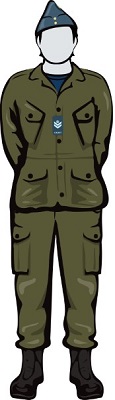
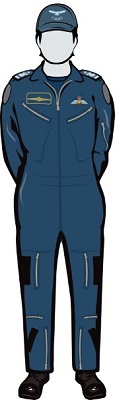
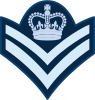
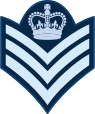
- General cadet knowledge: history, rank, and dress
- Foot drill
- Introduction to aviation, flight, and aircrew survival
By the end of Level 1
By the end of Level 1, a cadet is comfortable in the squadron, can perform basic drill, understands how the program works, and has a foundation in aviation and field skills.
Level 2 Building skills Taking part with more independence and going deeper into aviation and the field.
Topics
- Citizenship and community service
- Leadership as an active team member
- Personal fitness and recreational sports
- Air rifle marksmanship progression
- Survival, navigation, and orienteering
- Principles of flight and meteorology
- Aerospace and aerodrome operations
- Drill and ceremonial
By the end of Level 2
By the end of Level 2, a cadet takes part more independently, can handle navigation and survival tasks on a field exercise, and has a deeper grounding in aviation theory.
Level 3 Taking responsibility Beginning to lead small teams and to instruct junior cadets.
Topics
- Leading a small team
- Introduction to instructional technique
- Community service and citizenship
- Fitness and marksmanship
- Field and survival skills
- Aviation: navigation and weather
- Aerospace and aircraft
By the end of Level 3
By the end of Level 3, a cadet can lead a small group, teach the basics to newer cadets, and carry real responsibility on parade and in the field.
Level 4 Instructing and leading Planning and delivering instruction, mentoring junior cadets, and advanced aviation.
Topics
- Leadership theory and practice
- Instructional techniques: planning and delivering lessons
- Mentoring junior cadets
- Advanced aviation and aerospace
- Preparing for specialized summer training
By the end of Level 4
By the end of Level 4, a cadet is a capable instructor and junior leader, and is eligible for specialized summer courses such as advanced aviation.
Level 5 Senior leadership Leading the cadet body, mentoring across the squadron, and senior appointments.
Topics
- Advanced leadership and management
- Mentoring and coaching cadets at every level
- Helping plan and run squadron activities
- Advanced aviation and aerospace
- Preparing for senior appointments and national scholarships
By the end of Level 5
By the end of Level 5, a cadet is a senior leader and mentor for the squadron, and is eligible for the most advanced opportunities, including pilot scholarships.
Curriculum source: National Defence Canada, Cadet Publications (the A-CR-CCP-801 to 805 series).
Moving up
Promotions
Cadet rank generally advances as a cadet completes each training level over the year, so most
cadets move up about once a year. Promotion is earned, not automatic. It depends on:
- Completing the training and attendance expected for the current level
- Meeting the dress, drill, and conduct standard expected of the next rank
- Demonstrated effort, participation, and leadership
Senior ranks and leadership appointments (such as the Warrant Officer roles) are awarded
through a merit review board that considers a cadet's whole record, not time served alone. The
officer team explains the specific requirements at each level.
Recognition
Medals and awards
Cadets are recognized for achievement, service, and leadership. Alongside the level badges earned
through training, there are national and provincial honours, long-service recognition, and
squadron awards presented each year at the Annual Ceremonial Review.
Our Badges & insignia guide explains each badge, wing, and award in plain language, with a picture of each. Cadets can also apply for real scholarships toward college, university, and flight training, see Scholarships & awards.
Beyond the squadron
Summer training
Cadets can apply for funded summer courses at Cadet Training Centres (CTCs) across the country,
from a two-week introduction to multi-week specialist courses. These are optional, and
selection is competitive. Survival and marksmanship courses are especially popular.
Who can go, and when: summer courses require a cadet to have completed at least their first full training year. Every course, in person or online, needs Training Year 2 or higher, so first-year (Level 1) cadets are not eligible; the introductory summer course that new cadets could once attend is no longer offered. The longer specialist courses and the pilot scholarships need higher levels again, plus minimum ages of 16 or 17.
Open to all cadets
Popular courses shared across sea, army, and air cadets, and a great way to build a skill and meet cadets from across the country.
General training
The shortest summer course (about two weeks). Open once a cadet has finished their first year, it is a broad introduction to camp life and the streams cadets can specialize in.
Marksmanship
One of the most popular courses: air-rifle target shooting under close supervision, from the fundamentals up to coaching and competition.
Survival
Field and survival skills: shelter, navigation, and living and moving safely in the outdoors.
Fitness and sports
Physical fitness, coaching, and recreational and competitive sport.
Military band and pipe band
Music training for cadets who play, or want to learn, a band or pipe-band instrument.
Drill and ceremonial
Advanced drill, parade commanding, and ceremonial skills for cadets who enjoy the precision side of the program.
Air Cadet courses (limited spots, strong competition)
These aviation courses and the pilot scholarships are specific to air cadets. Places are few and selection is very competitive, based on a cadet's training level, performance, and a national selection board. See Scholarships & awards for how the flying scholarships work.
Aviation Technology and Aerospace
A two-week introduction to aerospace, airport operations, and aircraft manufacturing and maintenance.
Advanced Aviation
A longer course building specialist knowledge and instructional skill in aviation, communication, and meteorology.
Glider and Power Pilot scholarships
Multi-week summer courses where selected senior cadets train to fly solo and earn a Transport Canada glider or private pilot licence. Highly competitive, with very limited spots (glider from age 16, power from 17).
See the full list on the
official Cadets summer training page,
including the courses open to all cadets
and the survival courses.
Staff cadets (paid)
Cadets 16 and older can return to a Cadet Training Centre as staff cadets, taking on responsibility and earning a training bonus for the time they work.
Opportunities
Scholarships and opportunities
The Air Cadet League of Canada and its Alberta Provincial Committee offer scholarships and unique
opportunities to cadets who put in the work. Cadets are strongly encouraged to apply.
Glider Pilot Scholarship
A six-week summer course where successful cadets earn a Transport Canada glider pilot licence. Open to senior cadets who qualify.
Power Pilot Scholarship
A seven-week course of flying and ground school leading to a Transport Canada private pilot licence. One of the program's flagship opportunities.
International Air Cadet Exchange (IACE)
A two-and-a-half-week exchange where selected senior cadets travel abroad to visit aviation, cultural, and historical sites and meet cadets from other nations.
Effective Speaking
A public-speaking program and competition that builds confidence and communication skills, advancing from the squadron to regional, provincial, and national levels.
Post-secondary scholarships
The Air Cadet League offers post-secondary scholarships and bursaries to help cadets continue their education after the program.
Alberta provincial awards
The Alberta Provincial Committee offers its own recognition and scholarships for Alberta cadets.
Expectations
Cadet code of conduct
Every cadet agrees to the national Cadet Code of Conduct, signed by both the cadet and a parent
or guardian. It keeps the squadron a safe and respectful place for everyone. In short, cadets
agree to:
- Treat peers, juniors, and leaders with respect, and set a good example in dress and conduct.
- Be honest, and not lie, cheat, or steal.
- Use respectful language, with no profanity, harassment, or bullying, in person or online.
- Make no comments or conduct of a discriminatory or sexual nature, and keep appropriate boundaries.
- Not possess or use alcohol, drugs, tobacco, cannabis, or vaping products.
- Take care of issued kit and respect others' property and privacy.
- Put safety first, and stop and report any wrongdoing or unsafe situation to a supervisor.
- Ask an adult staff member for help whenever a situation is beyond their authority.
This is a plain-language summary of the national Canadian Cadet Organizations Code of Conduct.
Cadets receive the full version to read and sign when they join.
Want more detail?
Cadets have the full curriculum available through Cadet365. For anything specific, reach out to
the officer team at 12air@cadets.gc.ca.