
A guide for families
For Parents
Everything you need to support your cadet through the training year, from first parade night to Annual Ceremonial Review.
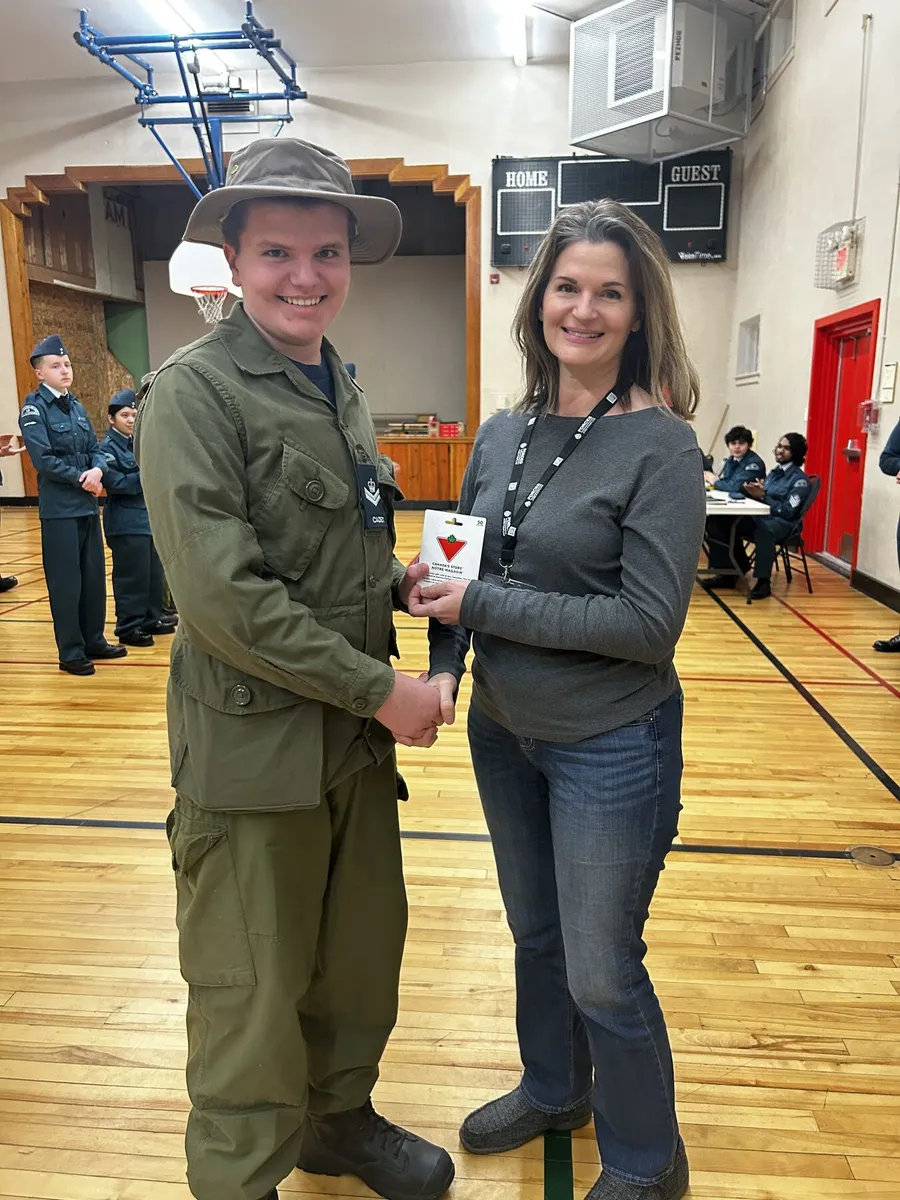
The training year runs September to mid-June, and a welcome for new families is held at the start of the year. The Sponsoring Committee's Annual General Meeting (AGM) is usually held near the end of the cadet year; the date is announced to families each year. If your cadet is joining mid-year, reach out to the officers at 12air@cadets.gc.ca for an orientation.
Schedule
Parade night schedule
Parade nights are every Wednesday throughout the training year.
A typical parade night runs as follows (times are 24-hour):
| 18:00 | Doors open. |
| 18:15 | Cadets arrive and are dropped off, already in uniform (there is no changing room). |
| 18:30 | Opening parade. |
| 19:00 | Training. |
| 20:00 | Break (the canteen is open). |
| 20:15 | Training. |
| 21:00 | Closing parade and announcements. Parents are encouraged to arrive in time to hear the announcements, or to ask their cadet what was shared. |
| 21:15 to 21:30 | Dismissal, closing duties, and clean-up. Please pick up during this window. |
| 21:45 | Squadron closed and locked. |
Need to report an absence? See the Absence reporting page for the two accepted ways to notify the squadron.
Getting here
Location and parking
Address
6770 129 Avenue NWEdmonton, AB T5C 1V7
We share the building with the 2051 19th Alberta Dragoons Royal Canadian Army Cadet Corps. The signage outside reads "Dragoons," not Air Cadets, so look for that.
Mailing address: P.O. Box 70137, Edmonton, AB (do not use for drop-off).
Parking
Park on the street, or in the lot between the squadron building and St. Francis of Assisi School.
Before parade
Care and preparedness
A few standing reminders that keep parade nights running smoothly for everyone.
-
Confirm an officer is present before drop-off
Do not leave your cadet at the building unless you have confirmed that a staff officer is already inside. If no officer is present, wait with your cadet until one arrives.
-
Feed your cadet before parade
Cadets are active for three hours. A proper meal beforehand helps them focus. The canteen is available during breaks and accepts loonies and toonies; it is a supplement, not a substitute for dinner.
-
Send a water bottle
The building can get warm during training. A labelled, refillable water bottle is part of standard kit.
-
Cadets tidy their space before dismissal
Part of cadet culture is leaving the space better than you found it. Cadets are expected to tidy their area before falling out for pick-up.
Dress standards
Uniform guidance
Uniforms are issued by the Department of National Defence at no cost to families. Cadets are responsible for maintaining them to a parade-ready standard.
Not sure of sizing? See how to measure your cadet at home on the Resources page.
Uniform basics
Cadets are responsible for their own uniform: washing, ironing, polishing boots, and sewing on badges. Doing this themselves is part of how the program builds responsibility, so the cadet does the work. Parents can teach the skill the first time if needed:
- Ironing the tunic and trousers to a sharp press
- Polishing boots to a mirror finish
- Sewing on badges and pins correctly and securely
- Washing and caring for the uniform fabric appropriately
Officers can advise on techniques for boot polishing and pressing if your cadet needs guidance.
Dress uniform (C1) home check
Most parade nights, cadets wear the green field training uniform (FTU). The blue dress uniform (C1) is worn for the CO's Parade, the Annual Ceremonial Review, Remembrance Day, and whenever it is announced. Run through this list before a C1 night.
- Hat: pressed, badge centred, sitting level
- Tunic: all badges and pins in the correct positions, pressed, no loose threads
- Trousers: pressed with a sharp crease
- Belt: clean, buckle polished and centred
- Name tag: correct position, clean
- Boots: polished to a mirror finish
- Hair: off the collar, neat, and conforming to regulations
Participation
Mandatory and optional events
Most activities are voluntary enrichment. A small number are mandatory and absences from them are noted in a cadet's record.
Mandatory
- Weekly parade night (every Wednesday)
- Annual Ceremonial Review (ACR), held in May or June
- Remembrance Day parade (November)
- Designated fundraising activities
Report an absence in advance for any mandatory event, and also for any optional activity your cadet signed up for but cannot attend. See the Absence page.
Optional (strongly recommended)
- Ground school (Saturdays during the training year)
- Field training exercises (FTXs)
- Marksmanship, drill team, and band
- Cyber training on Saturdays (CyberPatriot and Maple Defender)
- Effective speaking, sports, and other enrichment activities
Participation in optional activities contributes to promotions and awards but is never compulsory.
Field exercises
What to pack for a field exercise
A few times a year cadets head out for a weekend Field Training Exercise (FTX). A full kit list, the dates, and the location go home before each one. The list below is a typical example so you can plan ahead. Pack for the weather, in layers.
Sample kit list
- Field Training Uniform (if issued)
- Waterproof pants and rain jacket
- Winter jacket
- Waterproof boots
- Extra hiking boots or shoes
- Sweater or long-sleeve shirt
- Hat (Tilley or ball cap)
- Gloves, toque, and scarf
- Long underwear (top and bottom)
- 6 pairs cotton socks, 4 pairs wool socks
- 3 undershirts or t-shirts
- 4 pairs underwear
- 2 pairs pants (avoid denim)
- Sleeping attire (cotton or fleece)
- Sleeping bag or blanket, bed sheet
- Pillow (optional)
- Toiletries and any medications
- Small backpack with two straps
- Water bottle (full) and a travel mug
- Flashlight and spare batteries (labelled)
- Pen and notebook
- Sunscreen and lip balm
- Small pocketknife, optional, blade under 3 inches
Good to know
- Pack enough warm changes. Tight or dirty clothes are cold clothes, and sites are often wooded and damp.
- Kit is inspected on arrival. For safety, a cadet without the right clothing or equipment may not be able to take part, so please pack the list rather than drop-and-run.
- Label gear with the cadet's name.
Not permitted
Knives with a blade over 3 inches, matches, and electronics other than a phone or camera. Smoking, vaping, and alcohol are never permitted. Unauthorized items are held and returned after the exercise.
Staying informed
Communication channels
We use a mix of platforms. Here is what each one is for and when to use it.
Officer contact
For questions about training, absences, uniform issues, or anything that needs an officer's attention:
This is the shared officer inbox. There is no squadron phone number.
Weekly parent updates
A weekly email carries the schedule, dress of the day, any pick-up changes, and upcoming events. You are not added automatically when your cadet enrolls, so sign up for the mailing list or ask the Sponsoring Committee to add you.
Signed up but not seeing it? Check your spam or junk folder. Still missing? Email the Sponsoring Committee at all@12aircadets.ca.
SSC (Sponsoring Committee) general
For SSC business, volunteering, or fundraising enquiries:
Payments
For Volunteer Bond payments, receipts, or hardship enquiries:
See the Payments page for full details.
Cadet365 (Microsoft Teams)
Cadets use the DND-provided Cadet365 platform (Teams and Outlook) for training-year communication with officers and peers. The Attendance channel in the "T-NW-12 Air" team is one of the two accepted ways to report an absence.
Parents, please make sure your cadet collects their Cadet365 credentials, signs in successfully, and gets in the habit of checking Teams at least a couple of times a week. Almost everything is posted there, so most "we never heard about it" situations come down to a cadet not using Teams. If your cadet cannot sign in, see password and account help on the Resources page.
See the Absence page for details.
The squadron Facebook page carries news, photos, and event highlights. It is not a substitute for the weekly email or direct officer contact.
Partnership
Parents' code of conduct
The cadet program works best as a respectful partnership between families and the squadron. These are not rules you sign or that anyone polices, just the things we ask of families, and try to live up to ourselves, so the squadron runs well for every cadet.
- 1. Support the program's goals. Encourage your cadet's participation in training and activities, and reinforce the values of respect, responsibility, and citizenship at home.
- 2. Raise questions through the right channels. Officers look after cadet safety and the training program, and they welcome parents' questions. If something comes up, bringing it to them directly (see below) is always the best first step.
- 3. Model respectful conduct. Everyone in the squadron community, cadets, staff, volunteers, and families alike, treats one another with courtesy and respect. Aggressive, threatening, or disrespectful behaviour toward anyone is not acceptable.
- 4. Be on time for drop-off and pick-up. Officers are volunteers. Consistent late pick-up keeps staff waiting at the end of a long evening. If you are running late, contact the squadron promptly.
- 5. Do not drop off your cadet unsupervised. Confirm that an officer is in the building before leaving. Your cadet's safety is a shared responsibility between parents and staff.
- 6. Keep your contact information current. Notify the officers if your phone number, email, or emergency contacts change. Officers need to be able to reach you during parade nights.
- 7. Report absences in advance. Use one of the two accepted absence methods before the parade begins. Cadets are expected to report their own absences, but parents should confirm this has been done. See the Absence page.
- 8. Support uniform standards. Help your cadet arrive in a clean, well-kept uniform; the pre-parade check list above makes it quick. A flight looks and feels its best when everyone turns out sharp, so each cadet's effort lifts the whole team.
- 9. Participate where you can. The SSC depends entirely on parent volunteers. Even occasional help with events, transport, or snacks makes a real difference.
- 10. Respect privacy. Do not share other families' contact information, photos of cadets who are not your own, or internal squadron communications without permission.
- 11. Honour financial commitments. The optional Volunteer Bond and designated fundraising support the program directly, and the bond is refundable through volunteering and fundraising. If financial hardship is a concern, contact the SSC confidentially. No cadet is excluded for inability to pay.
- 12. Use social media responsibly. Posts about cadets or squadron events should be positive and should not identify minors without their parents' consent. Do not publish internal communications or complaints publicly.
Concerns
Raising a concern
A big part of the program is helping cadets become responsible, self-reliant young people. We encourage cadets to raise and work through issues themselves, using their chain of command, before a parent steps in. Giving your cadet the chance to advocate for themselves is part of how they grow.
If your cadet has raised something through their chain of command and it has not been addressed, that is the right time for a parent to get involved. Email is the best first step, and we can arrange a time to meet and discuss if needed.
- 1
Let the cadet raise it first
Encourage your cadet to bring training and day-to-day matters to their cadet leaders and officers themselves. Self-advocacy is a skill the program is built to develop.
- 2
If it is not addressed, email us
For a training or cadet matter, email the officers at 12air@cadets.gc.ca. For Sponsoring Committee matters such as fundraising, events, or fees, email the SSC at all@12aircadets.ca.
- 3
Meet to discuss if needed
If a matter needs a fuller conversation, we will arrange a time to meet rather than trying to resolve everything in front of cadets on a parade night.
Above all, we are a community and we look out for one another. If something is troubling you or your cadet, whether it is about the program or life outside it, reach out to the Sponsoring Committee or the staff. We would rather know, so we can help or point you toward support.