Customs and traditions
Customs & Traditions
The how and the why behind squadron life. These are the customs cadets learn through the year, where they come from, and what they mean.
Parade night and drill
Parade night is the squadron's weekly meeting, one evening a week from September to June. The word "parade" means both the formal formations that open and close the night and the gathering itself. At the opening parade, cadets form up by flight, come to attention, and are handed over to the duty officer or the Commanding Officer. The evening then moves into training by level and activities such as drill, marksmanship, sports, and ground school. Once a month the CO's Parade is a fuller dress parade that the Commanding Officer inspects, where promotions, awards, and recognitions are presented.
Drill, the precise movements cadets learn on the parade square, is not marching for its own sake. The drill manual describes its aim as building the discipline, alertness, precision, pride, and teamwork that let a group act as one.
Saluting and the Colours
The salute is a mark of trust and respect, and a part of service discipline. It acknowledges a person's rank or appointment, not the individual. Cadets pay compliments to officers and senior cadets: a junior cadet comes to attention and names the rank when passing a Flight Corporal, Sergeant, or Flight Sergeant, and Warrant Officers are addressed as "Sir" or "Ma'am" and saluted. Compliments are also paid to the Sovereign and the Royal Family, the Governor General, and the uncased Colours, the ceremonial flags. When the national or royal anthem or a royal salute plays, everyone outside a formed group salutes from the first note to the last.
Dress of the day
Air cadets have a set of numbered orders of dress, and the Commanding Officer sets the "dress of the day" for each parade and activity so everyone knows what to wear. The main orders are:
- C1, Ceremonial dress. The full blue uniform: tunic, dress shirt and tie, wedge cap, parade boots, and medals if held. Worn for CO's Parades, the Annual Ceremonial Review, Remembrance Day, and formal ceremonies.
- C2, Mess dress. A formal evening order (white shirt, black bow tie) worn for the mess dinner, usually once a year.
- C3, Service dress. The everyday blue dress with shirt and tie. The lighter version, without the tunic and tie, is often worn on warmer training nights.
- C5, Training dress. The field training uniform (FTU), the green uniform, worn for most regular training nights, field exercises, and outdoor activities. Qualified cadets wear a flight suit for familiarization flying.
(There is no C4 for air cadets; the numbering skips it so the orders line up across the sea, army, and air programs.) On a typical night many cadets are in the field uniform, while senior cadets and those holding parade positions often wear the blue service dress. The squadron publishes the dress of the day each week.
-
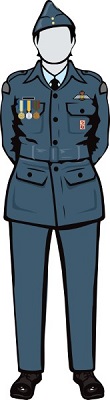
C1
Ceremonial dress
CO's Parade, the ACR, Remembrance Day, formal occasions
-
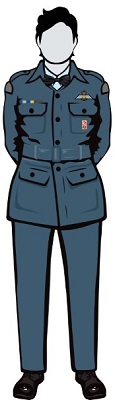
C2
Mess dress
The mess dinner
-
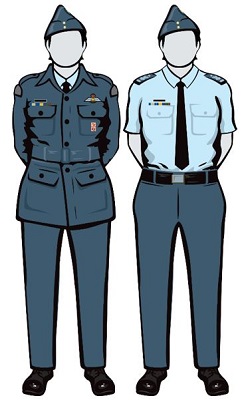
C3
Service dress
Everyday blue dress
-
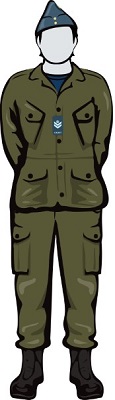
C5
Field training uniform (FTU)
Most training nights and field activities
-
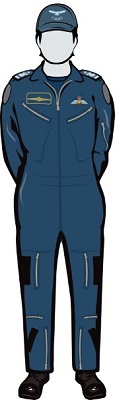
C5B
Flight suit
Familiarization flying and gliding
Uniform reference figures from the CJCR Group Dress Instructions, National Defence / Government of Canada. An official work reproduced for non-commercial purposes; not produced in affiliation with or endorsed by DND or the Canadian Armed Forces.
The badge, the Ensign, and the motto
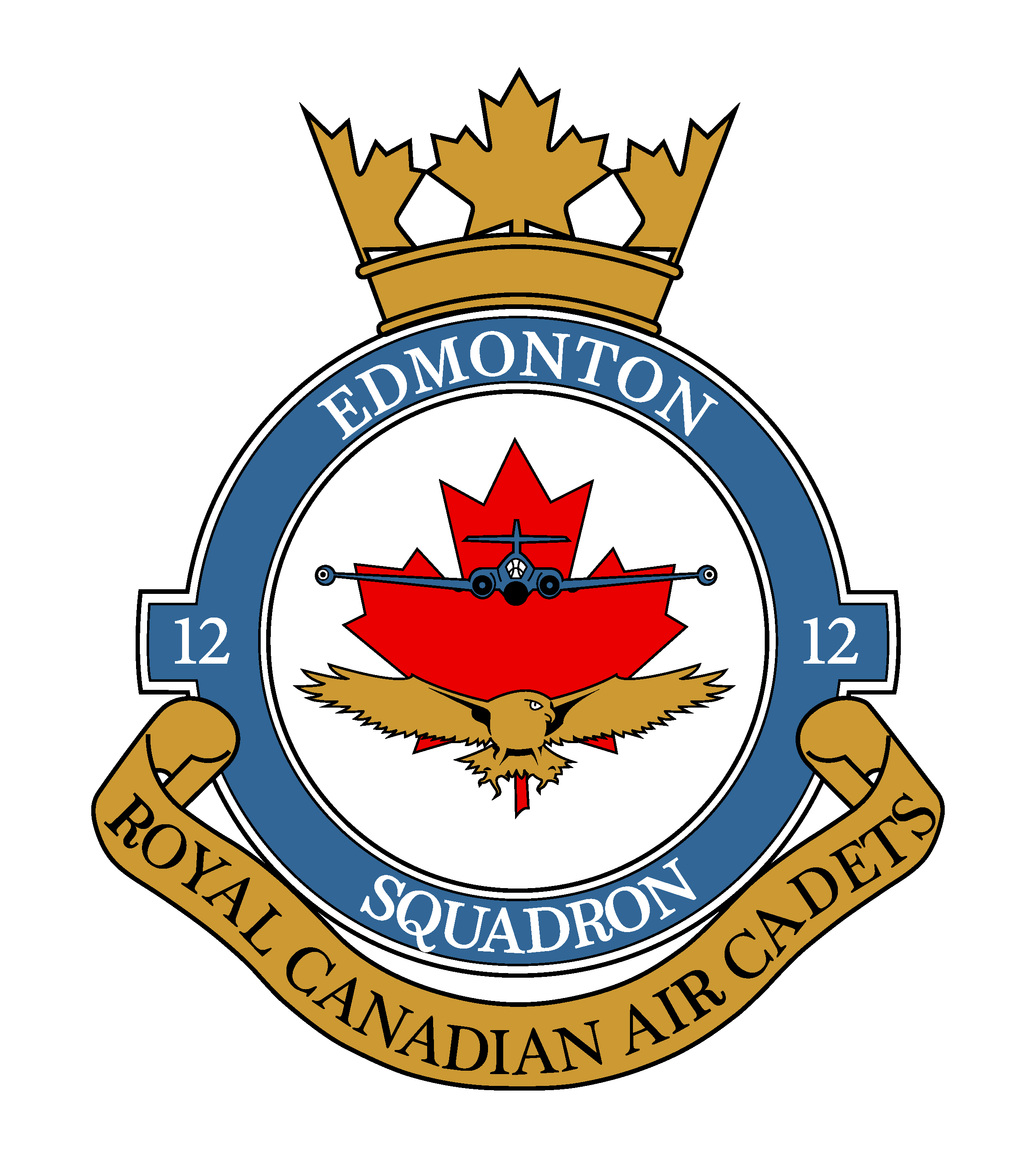 Our squadron crest
 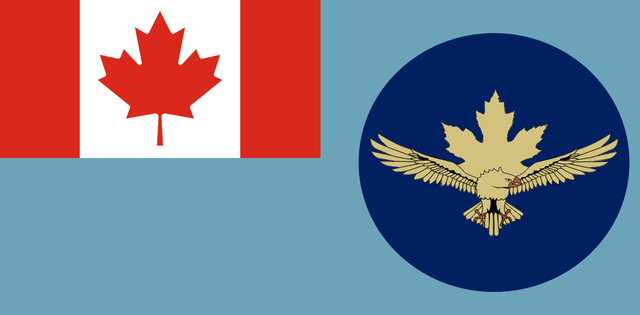 The Royal Canadian Air Cadet Ensign
 Every part of the air cadet identity carries meaning. The Royal Canadian Air Cadets badge sets a flying falcon, for flight and aviation, within a wreath of maple leaves, for Canada, beneath St. Edward's Crown, which marks the cadets as a Royal institution with a link to the Crown, above a bilingual scroll.
The movement's own flag, the Royal Canadian Air Cadet Ensign, is air-force pale blue and carries a roundel with a gold eagle and maple leaf drawn from the original 1941 badge. It was first approved by King George VI in 1941; in 1971 Queen Elizabeth II approved a new version that replaced the Union Jack in the corner with the Canadian Maple Leaf flag. The ensign flies at squadron headquarters and is carried by the flag party on parade.
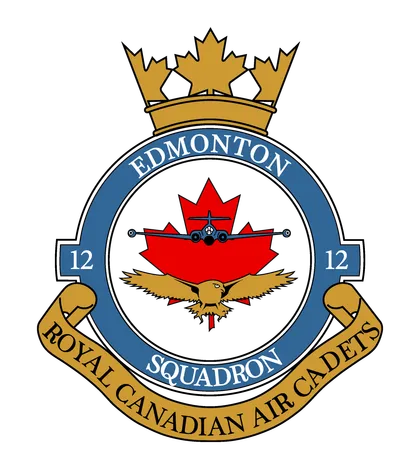
The motto, "To learn. To serve. To advance.", is the cadet movement's own. It was written in 1966 by a cadet, Robert Colwell of 625 Squadron in New Brunswick, which gives every cadet a real stake in it. Each squadron also carries its own crest, with elements chosen by its founders.
Days we mark
Three days anchor the air cadet year:
- Battle of Britain Sunday (mid-September). It remembers the air battle over Britain in 1940, when the Royal Air Force and its Commonwealth allies, including more than a hundred Canadian pilots, turned back the Luftwaffe. Air cadets have taken part in the ceremony since the RCAF formalized it in 1947.
- Remembrance Day (11 November). The squadron's most visible day. Cadets stand as sentries at the cenotaph, take part in the parade and the two minutes of silence, and help with the Legion's poppy campaign in the weeks before. "In Flanders Fields" is often read.
- The Annual Ceremonial Review (May or June). The formal parade that closes the training year, where an external Reviewing Officer inspects the squadron and promotions and awards are presented. Families are invited.
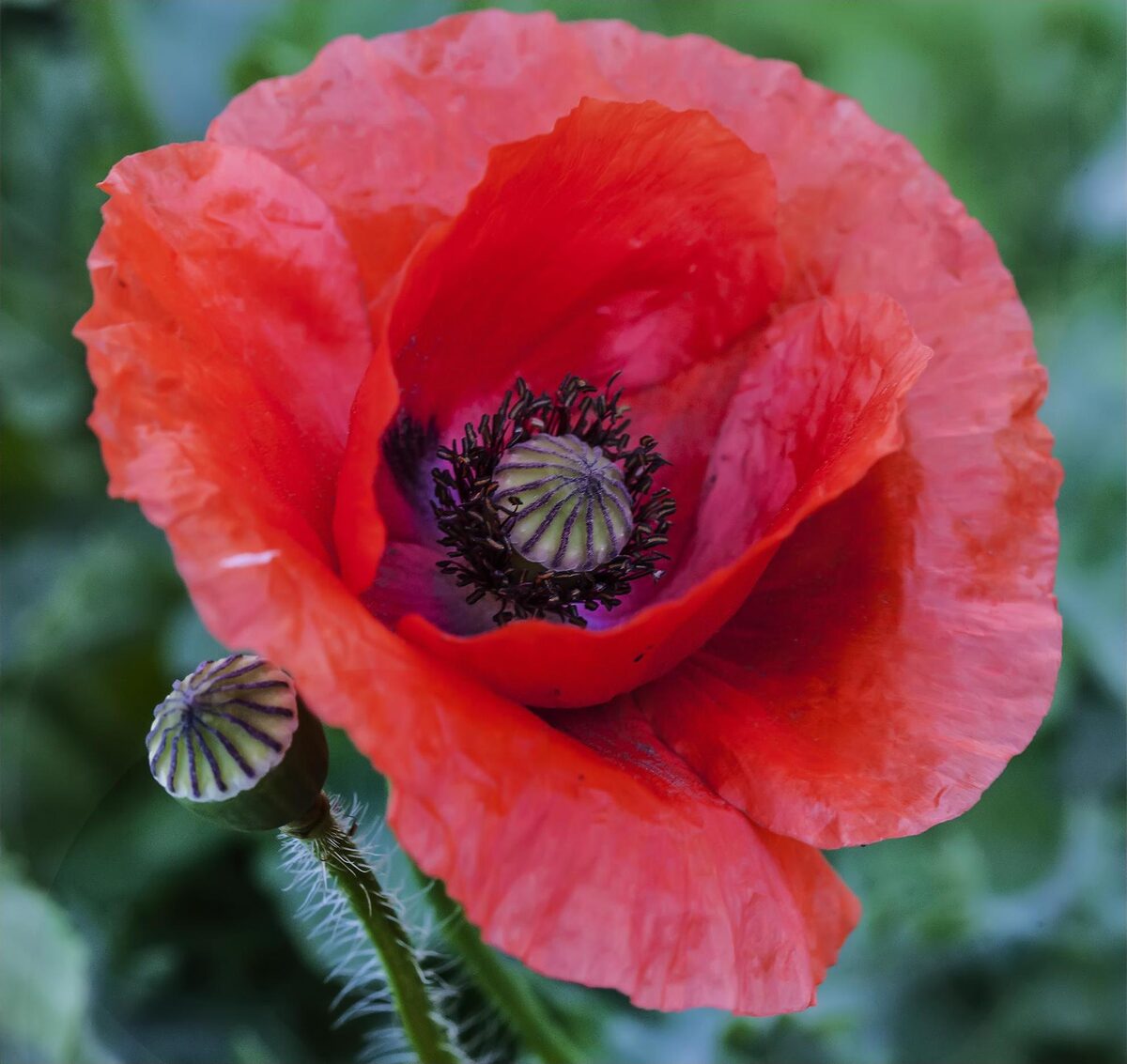
Why the poppy? In the spring of 1915, after heavy fighting in the fields of Flanders, red poppies bloomed across the churned earth and the fresh graves. A Canadian military doctor, Lieutenant-Colonel John McCrae, captured the sight in his poem "In Flanders Fields," written after the Second Battle of Ypres. The image took hold, and in 1921 the poppy was adopted in Canada as the symbol of remembrance. Cadets wear one each November and help share them in the community.
In Flanders Fields
In Flanders fields the poppies blow
Between the crosses, row on row,
That mark our place; and in the sky
The larks, still bravely singing, fly
Scarce heard amid the guns below.
We are the Dead. Short days ago
We lived, felt dawn, saw sunset glow,
Loved and were loved, and now we lie
In Flanders fields.
Take up our quarrel with the foe:
To you from failing hands we throw
The torch; be yours to hold it high.
If ye break faith with us who die
We shall not sleep, though poppies grow
In Flanders fields.
Lieutenant-Colonel John McCrae, 1915
Cadets also take part in Veterans' Week activities and other community observances through the year.
The Mess Dinner
The squadron's most formal evening, a tradition carried from the Royal Canadian Air Force, with its own order of ceremony, toasts, and the moving Missing Aviator Table. Read the full mess dinner guide.
Adapted from the official cadet dress and drill instructions, the CAF Manual of Drill and Ceremonial, the Air Cadet League of Canada, and Veterans Affairs Canada.